
Abstract:
Sound View Innovations, LLC, recently learned how much damage a single word can do to a patent infringement lawsuit. Sound View Innovations sued Hulu, LLC, for infringement of a method claim with steps Sound View Innovations argued could be performed in any order. But the District Court determined that two steps—“receiving a request for an SM object from one of said plurality of clients at one of said plurality of helper servers” and “allocating a buffer at one of said plurality of HSs to cache at least a portion of said requested SM object”—had to be performed in the order listed. Hulu, however, pre-allocated its buffers, meaning the buffers were allocated before a request for an SM object was received. Thus, Hulu failed to infringe Sound View Innovations’ asserted patent. The Court of Appeals for the Federal Circuit affirmed the District Court’s dismissal of the patent lawsuit because the word “received” indicated, by both grammar and logic, that the two steps were ordered. Patent practitioners must be vigilant in looking for terms that may inadvertently limit claimed steps to a particular ordering.
Case Summary:
Decision: Sound View Innovations, LLC v. Hulu, LLC, Case No. 2024-1092, available at https://www.cafc.uscourts.gov/opinions-orders/24-1092.OPINION.1-29-2026_2640097.pdf (Federal Circuit Jan. 29, 2026)
Oral Arguments: https://www.cafc.uscourts.gov/oral-arguments/24-1092_08082025.mp3 (held Aug. 8, 2025)
Patent: US 6,708,213 B1, available at https://patents.google.com/patent/US6708213B1/
Judges: Sharon Prost; Evan Wallach; Raymond Chen (authoring)
Lower Tribunal Opinion: Sound View Innovations, LLC v. Hulu, LLC, Case No. 2:17-cv-04146, Paper Nos. 1091 (Order on Motion to Exclude; Sept. 8, 2023) and 1094 (Judgment; Sept. 25, 2023) (C.D. Cal)
Topics: Patent Infringement; Claim Interpretation (Grammar and Logic); Ordered Limitations
Sound View Innovations sued Hulu for infringement of claim 16 of US 6,708,213 B1 (the ’213 patent).
Claim 16 of the ’213 patent (emphasis added):
16. A method of reducing latency in a network having a content server which hosts streaming media (SM) objects which comprise a plurality of time-ordered segments for distribution over said network through a plurality of helpers (HSs) to a plurality of clients, said method comprising:
receiving a request for an SM object from one of said plurality of clients at one of said plurality of helper servers;
allocating a buffer at one of said plurality of HSs to cache at least a portion of said requested SM object;
downloading said portion of said requested SM object to said requesting client, while concurrently retrieving a remaining portion of said requested SM object from one of another HS and said content server; and
adjusting a data transfer rate at said one of said plurality of HSs for transferring data from said one of said plurality of helper servers to said one of said plurality of clients.
The District Court dismissed the patent suit because Hulu’s process relied on a pre-allocated buffer—a buffer allocated before receiving a request for a streaming media object. Specifically, the District Court determined that claim 16 required “first ‘receiving a request for an SM object from one of said plurality of clients at one of said plurality of helper servers,’ then ‘allocating a buffer at one of said plurality of’” (emphasis added). Based on this ordering, the District Court concluded that Hulu’s process, which performed the two steps in the opposite order, did not infringe claim 16 of the ’213 patent.
The Court of Appeals for the Federal Circuit accepted the interpretation of the two steps as being ordered because “both the grammar and logic of” claim 16 required performing the receiving step before the allocating step. Specifically, the receiving step recited “receiving a request for an SM object” while the allocating step recited “allocating a buffer . . . to cache . . . said requested SM object.” “Grammatically, ‘a request for an SM object’ in the first limitation provides an antecedent basis for ‘said requested SM object’ in the second.” And logically, for the use of the past tense description (i.e., “received”) in the receiving step “to make sense, a request must have occurred before the object can be described as ‘requested.’ Indeed, only after a request is received does the SM object acquire the status of being ‘requested.’”
During oral arguments, Sound View Innovations tried comparing “receiving a request for an SM object” to a customer ordering a product, and “allocating a buffer . . . to cache . . . at least a portion of said requested SM object” to a company “allocating a warehouse to store goods ordered by customers.” Sound View Innovations argued a seller wouldn’t wait until customers ordered goods before building or selecting the warehouse for storing those goods. But this analogy was quickly shot down from the bench. Arguments quickly shifted to comparing “receiving a request for an SM object” to a radio station caller requesting that the radio station play a particular song (i.e., a “requested song”) and to comparing “allocating a buffer . . . to cache . . . at least a portion of said requested SM object” to the radio station allocating a time period for playing the song. The radio station analogy did not help Sound View Innovations’ case.
Sound View Innovations argued that other claims either used markers or conditional steps (e.g., “allocating a first ring buffer” occurring “upon receiving said first request”) to show the ordering of steps, and thus claim 16’s lack of such markers or conditional steps demonstrated that claim 16 did not have such an ordering. The Court of Appeals for the Federal Circuit found this argument unpersuasive because the grammar and logic of claim 16 already imposed an ordering, and thus alternative indications of the ordering of the steps (e.g., markers or conditional steps) were simply unnecessary.
Sound View Innovations also argued that figure 7B of the ’213 patent showed allocation of a buffer before an SM object was received, and thus depicted an embodiment that would be excluded by the interpretation of the claim language as requiring a particular order. Figure 7B of the ’213 patent is reproduced below.
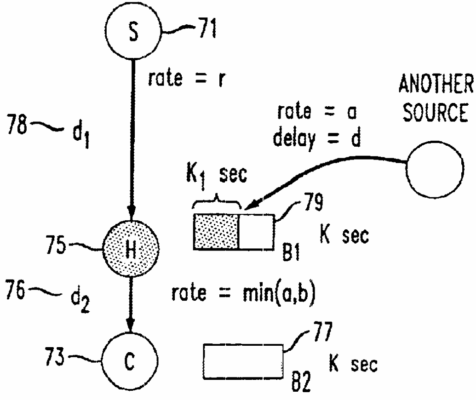
Figure 7B of the ’213 patent illustrates content server S 71 sending streaming data to client C 73 via intermediary helper server HS 75 (depicted as H in the figure). This figure depicts buffer B1 of intermediary HS 75 having K1 seconds of data from another source such as a local disk of intermediary HS 75 or another helping server.
The Court of Appeals for the Federal Circuit determined that figure 7B did not depict the allocation of buffer B1. Similarly, the supporting description in the specification of the ’213 patent did not describe the allocation of buffer B1. Therefore, the Court of Appeals for the Federal Circuit found that Figure 7B was irrelevant to understanding the scope of claim 16.
Because Hulu’s process used a pre-allocated buffer to store a received SM object (i.e., it performed an allocating step before a receiving step instead of vice-versa), the Court of Appeals for the Federal Circuit sustained the District Court’s non-infringement holding.
Practice Tip:
In interpreting a patent claim, every word is presumed to matter. In Sound View Innovations, the word “received” established an order for steps of a method claim that excluded Hulu’s use of a pre-allocated buffer. Patent practitioners must be careful during claim drafting to ask if every word is needed. This is especially true with steps of a method that could be performed in any order; method steps may become ordered based on one word.